Compressor Stall vs Surge in Jet Engines
Compressor stall is blade-passage flow separation, often local or rotating; surge is a system-wide oscillation. Learn the map, causes, and protection.
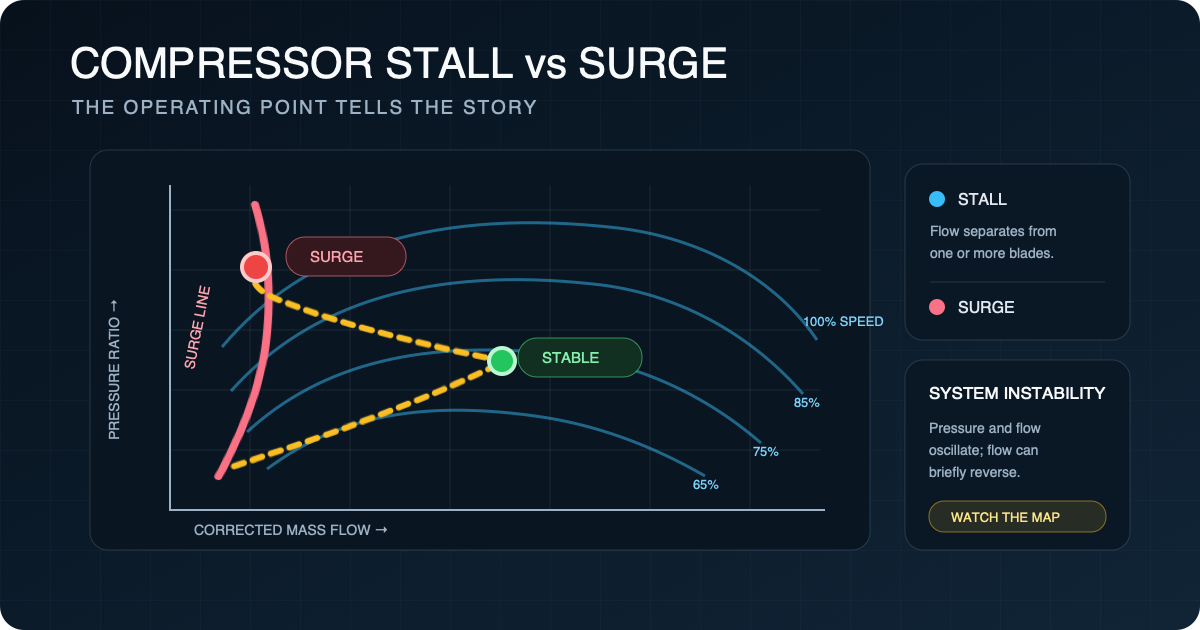
A jet at full power sounds remarkably steady — thousands of blades doing violent work while the airflow behaves as if drawn with a ruler. Then the compressor loses its grip. Pressure collapses, thrust disappears, and the engine may answer with a startling bang.
People call that a compressor stall and a surge, often interchangeably. Aerodynamically, though, the words describe different scales of instability. This article focuses on the axial compressors used in aircraft gas-turbine engines; centrifugal and industrial compressor systems use related concepts but different maps and hardware.
Quick Answer: Stall vs Surge
A compressor stall begins at the blades. Airflow separates in one or more blade passages or rows, so they stop adding pressure efficiently. The separated region is often local or forms rotating stall cells, but circumferentially uniform stall can also occur.
A compressor surge involves the whole compression system. Compressor delivery, downstream pressure, and mass flow enter a large oscillation; in a deep surge, flow can briefly reverse through the compressor before forward flow re-establishes. Stall can trigger surge, but a stalled blade row and a surging engine are not the same physical event.
| Compressor stall | Compressor surge | |
|---|---|---|
| Scale | Blade passages or rows; often local or rotating, sometimes annulus-wide | Compressor plus the connected engine flow system |
| Defining behavior | Flow separates from blade airfoils | Annulus-averaged pressure and mass flow oscillate |
| Reverse flow | Not required | Possible, and characteristic of deep surge |
| Persistence | Can be steady or rotate circumferentially | Usually a repeating pressurize–collapse–recover cycle |
| Relationship | May exist without surge | Commonly begins after compressor flow has stalled |
Operational speech is less strict. The FAA's turbofan malfunction guide notes that an engine surge is often called either a “compressor surge” or “compressor stall.” A crew observes the bang, yaw, heat, and thrust loss — not individual blade passages.
What Does It Mean for a Compressor Blade to Stall?
An axial-compressor blade is an airfoil. Its job is to turn and diffuse the incoming air, trading velocity for pressure as rotor and stator rows pass the flow rearward. Like a wing, it works only across a useful range of incidence angles.
Move too far from the design condition and the boundary layer can separate from the blade surface. The passage then produces less pressure rise and more loss. That is blade stall.
Separation often starts nonuniformly. One common outcome is a low-throughflow cell that migrates around the annulus as neighboring passages accept more air. This is rotating stall: an asymmetric pattern orbiting the compressor, usually slower than the rotor, as measured in NASA's multistage axial-compressor experiments.
Forward flow can continue through most of the annulus while a stall cell rotates inside it. Pressure ratio and efficiency suffer; blade loading and vibration rise. There is instability, but not necessarily the engine-wide empty-and-refill cycle of surge.
What Makes Surge a System-Wide Event?
The compressor pushes into pressurized ducts, combustor, turbine, and nozzle. That downstream air stores energy; the compressor's ability to hold it back depends on shaft speed and mass flow.
Near the stability limit, a small reduction in flow raises blade incidence and encourages separation. If enough of the compressor stalls, it can no longer sustain the downstream pressure. The compressed air then discharges toward the lower-pressure side; in a deep event, some air flows upstream through the compressor and may discharge from the inlet.
Once downstream pressure falls, forward flow can return. If the operating condition has not changed, pressure builds until the system crosses the limit again. The German Aerospace Center's description of the surge cycle separates it into pressurization, flow breakdown, reversed flow, and regeneration. DLR notes typical surge frequencies around 10 Hz; real frequency and severity depend on the installation.
That dependence is important. Rotating stall is an aerodynamic pattern inside the compressor. Surge is a coupled instability of the compressor and its system.
How to Read a Compressor Map
A compressor map turns that invisible operating range into a picture. Labels vary, but the anatomy is consistent.
Axes: Flow and Pressure Ratio
The horizontal axis is usually corrected mass flow, adjusted for inlet temperature and pressure. The vertical axis is total pressure ratio: outlet total pressure divided by inlet total pressure.
Corrected-Speed Lines
Curved lines represent constant corrected rotor speed. An engine moves along and between them as speed, inlet conditions, fuel, and downstream conditions change; the map is not a throttle chart.
Efficiency Islands
Closed contours mark equal efficiency. They resemble topographic rings, hence efficiency islands. The NASA NPSS introduction shows pressure ratio, corrected flow, speed lines, surge, choke, and islands in a worked compressor-map explanation.
Surge Line and Choke
The left side of the useful map is bounded by the surge line or stability line. Here flow is low for the pressure rise being demanded, blade incidence is high, and stable compression runs out.
At the far right, passages approach choke: local velocity reaches sonic conditions and little more corrected flow can pass. It is a high-flow capacity limit, normally bringing lower pressure ratio and efficiency rather than surge's violent reversal.
Between them lies the usable operating region.
What Is Surge Margin?
Surge margin is the deliberately preserved separation between the engine's operating line and its stability boundary. More margin makes the compressor tolerant of acceleration, inlet distortion, deterioration, and manufacturing variation. Reducing margin may permit a more aggressive operating line closer to peak efficiency or pressure-ratio capability, but leaves less buffer for disturbances.
There is no universal “distance to the line” formula. Manufacturers define pressure-ratio and flow relationships at comparable corrected conditions. On a simplified display, a positive percentage means remaining modeled stability buffer, not literal chart distance.
Why Rapid Acceleration Can Trigger Surge
Spool inertia is the heart of the transient. Fuel can increase quickly; a heavy rotor cannot instantly gain speed. Temperature and downstream pressure rise while airflow catches up, moving the operating point toward lower-flow, higher-loading territory.
A well-matched control schedules fuel so airflow and pressure rise stay compatible. An aggressive schedule asks the existing shaft speed to support more pressure than the compressor can stably deliver. Separation grows and the system discharges.
Throttle movement is only one route to the boundary. Other causes include:
- inlet distortion from crosswind, high angle of attack, or disturbed air;
- bird, ice, hail, or foreign-object ingestion;
- damaged, dirty, or eroded compressor blades;
- incorrect variable-stator or bleed-valve position;
- pneumatic-system faults or abrupt bleed demand;
- excessive tip clearance, internal deterioration, or mechanical damage;
- combustor, turbine, or nozzle changes that alter the compressor's downstream match.
A surge can be the malfunction itself or a symptom of damage elsewhere.
What Does a Stall or Surge Look and Sound Like?
A rotating stall may cause rumble, vibration, reduced pressure ratio, lost efficiency, and higher temperature while the engine still produces some thrust.
A full surge is harder to miss:
- one or more sharp bangs;
- an abrupt thrust loss and, on a multi-engine aircraft, yaw;
- rotor-speed or pressure-ratio fluctuations;
- rising or fluctuating exhaust-gas temperature;
- vibration;
- flame visible at the inlet or tailpipe in some events.
One may recover before instruments respond; a repeating or non-recovering event may accompany severe damage.
Surge imposes large cyclic aerodynamic loads and can excite blade vibration or flutter; repeated cycles consume fatigue life. Temperature excursions, flameout, and secondary damage are possible. A self-clearing surge does not necessarily imply structural damage, but it still requires the applicable operational and maintenance response.
How Engine Controls Protect Compressor Margin
Both hydromechanical and digital engine controls can schedule fuel and compressor geometry to preserve surge margin. A full-authority digital engine control adds sensor inputs, software logic, and authority, but it does not repeal compressor aerodynamics. NASA's tests of a J85 hydromechanical control describe acceleration fuel scheduling below surge and temperature boundaries, along with scheduled compressor geometry.
Direct surge-margin controls can include:
- acceleration and deceleration fuel schedules tied to corrected spool speed;
- fuel-flow limits based on compressor pressure and temperature;
- coordinated variable inlet-guide vanes and stator vanes;
- compressor bleed valves that unload stages at vulnerable conditions;
Separate digital limiters may also protect against overspeed, overtemperature, combustion instability, and bad sensor information. The key word is schedule: the pilot requests thrust, and the controller meters the path to it. Ingestion, hardware failure, severe distortion, or bad sensor information can still overwhelm protection.
Compare the Simulator's Unprotected and Digitally Limited Presets
The simulator includes two versions of the same modeled J85 gas path.
Start with the preset labeled J85 hydromechanical. Once running steadily, a rapid virtual throttle command can add fuel faster than spool airflow catches up. The reduced-order map point crosses a surrogate stability threshold, and the simulator switches to a low-flow stalled branch while downstream pressure blows down.
Repeat with the FADEC-retrofit J85. Its acceleration schedule limits fuel and keeps the modeled point inside the boundary.
The contrast is deliberately exaggerated for teaching: the first preset removes the acceleration clamp, whereas real hydromechanical J85 controls also scheduled fuel and compressor geometry. This is a simplified, reduced-order educational model, not manufacturer data, an approved training device, or a certification tool.
The model does not resolve individual blade passages, rotating stall cells, or negative airflow through the inlet. Its live display is a surrogate running line and stability line, not a measured J85 compressor map. The displayed margin is (surge pressure ratio − actual pressure ratio) / actual pressure ratio × 100.
For the preceding part of the sequence, see How Does a Jet Engine Start? Step by Step. For why a jet needs atmospheric airflow while a rocket does not, read Jet Engine vs Rocket Engine.
Compressor Stall and Surge FAQs
Are compressor stall and surge the same thing?
Not in aerodynamic analysis. Stall is flow separation in blade passages and may form rotating cells; surge is an oscillation of the overall compression system. In operational language, “compressor stall” is often used for the bang-and-thrust-loss event engineers would classify as surge.
Can rotating stall happen without surge?
Yes. A rotating stall cell can persist while average flow remains forward. The compressor loses efficiency and pressure capability, but the whole system does not necessarily enter a large flow-and-pressure cycle.
Does surge always reverse airflow?
Deep surge can reverse annulus-averaged flow through the compressor. Milder surge may produce large oscillations without sustained full reversal at every point, so reversal is a severity-dependent behavior rather than the only definition.
Is choke the opposite of surge?
They bound opposite sides of a compressor map, but they are not mirror-image events. Surge is the low-flow stability limit; choke is the high-flow capacity limit created by sonic regions in the passages.
What should a pilot do after a real compressor surge?
This article is not an operating procedure. Aircraft, engines, and phases of flight differ: follow the applicable aircraft flight manual, manufacturer and operator checklists, and your approved training.
Sources and Further Reading
- DLR — Surge: When the Air Flows Backwards Through the Engine
- NASA/TM-2007-214978 — Experimental Investigation of Rotating Stall in a Research Multistage Axial Compressor
- NASA/TM-2007-214690 — An Introduction to Thermodynamic Performance Analysis of Aircraft Gas Turbine Engine Cycles Using NPSS
- NASA TN D-7198 — Experimental Test Results of a Generalized Parameter Fuel Control
- FAA — Turbofan Engine Malfunction Recognition and Response Final Report