Jet Engine vs Rocket Engine: Which Is More Powerful?
Jets breathe air; rockets carry their own oxygen. That one difference decides thrust, efficiency, and top speed. The full comparison, with real numbers.
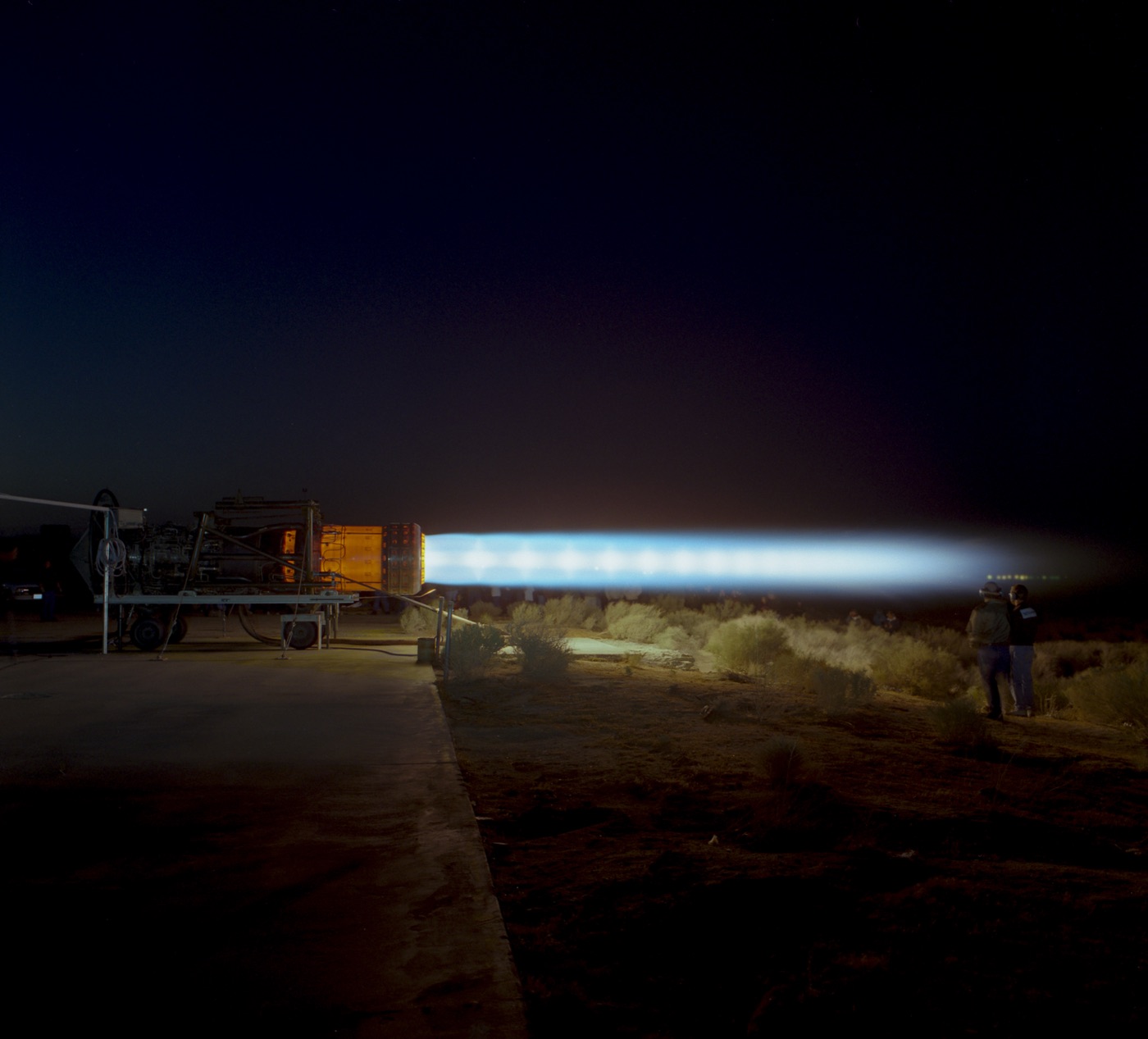
Above: the SR-71's J58 turbojet in full afterburner during NASA ground testing. (Photo: NASA)
A jet engine and a rocket engine both work the same way at the highest level: burn fuel, throw hot gas backwards, get pushed forwards. Newton's third law does not care which machine is doing the throwing.
But the two engines could hardly be more different in practice. One can run for fourteen hours and cross the Pacific on a tank of kerosene. The other burns through hundreds of tonnes of propellant in eight minutes — and is the only machine humans have built that works in space.
The question is: what actually separates them, and which one is "more powerful"? Let's break it down.
Quick Answer: Jet vs Rocket
The main difference: a jet engine breathes oxygen from the atmosphere, while a rocket engine carries its own oxidizer onboard — so a rocket works in space and produces roughly ten times more thrust, but a jet is roughly ten times more fuel-efficient.
A jet engine is air-breathing: it pulls oxygen from the atmosphere, so it only has to carry fuel. That makes it extremely efficient, but it stops working where the air runs out — and it can't push past roughly Mach 3 without melting its own inlet.
A rocket engine carries both fuel and oxidizer onboard. That makes it heavy and thirsty, but utterly independent of the atmosphere: full thrust at sea level, in the stratosphere, or in hard vacuum.
Raw thrust? Rockets win by an order of magnitude. Efficiency? Jets win by an order of magnitude. They are not rivals — they are answers to two different questions.
How a Jet Engine Works
A turbojet is a continuous-flow machine. Air never stops moving through it, and four things happen to that air in sequence:
- Suck — the inlet and compressor swallow air and squeeze it to 10–40 times atmospheric pressure.
- Squeeze — compression heats the air to several hundred degrees before any fuel is added.
- Bang — fuel is sprayed into the combustor and burns continuously, raising gas temperature past 1,200 K.
- Blow — hot gas expands through a turbine (which powers the compressor — the engine feeds itself) and accelerates out the nozzle.
Thermodynamically this is the Brayton cycle. The elegant part is the feedback loop: the turbine extracts just enough energy from the exhaust to spin the compressor that feeds it. Below a certain RPM that loop can't sustain itself — which is why jets need a starter motor to spool up, and why a flameout at low RPM is a real emergency.
The numbers: the General Electric J85 — the small turbojet you can start and fly in our engine simulator — produces around 2,500 lbf of thrust dry. At the other extreme, the GE9X turbofan on the Boeing 777X holds the world record at over 134,000 lbf.
How a Rocket Engine Works
A rocket engine skips the entire front half of the jet. No inlet, no compressor, no turbine in the gas path. Instead:
- Pumps (or tank pressure) force fuel and oxidizer into the combustion chamber at enormous pressure — around 300 bar in SpaceX's Raptor.
- The propellants burn at 3,300–3,600 K, hotter than the melting point of the chamber walls (the walls survive only because fuel circulates through them as coolant).
- The gas accelerates through a converging-diverging nozzle, going supersonic at the throat and exiting at 2,500–4,500 m/s.
Because the rocket brings its own oxidizer, the combustion chamber never needs the atmosphere. That is the entire trick. It is also the entire cost: oxidizer typically outweighs fuel 2.5-to-1, so most of a rocket's launch mass is oxygen it hauls along just to burn.
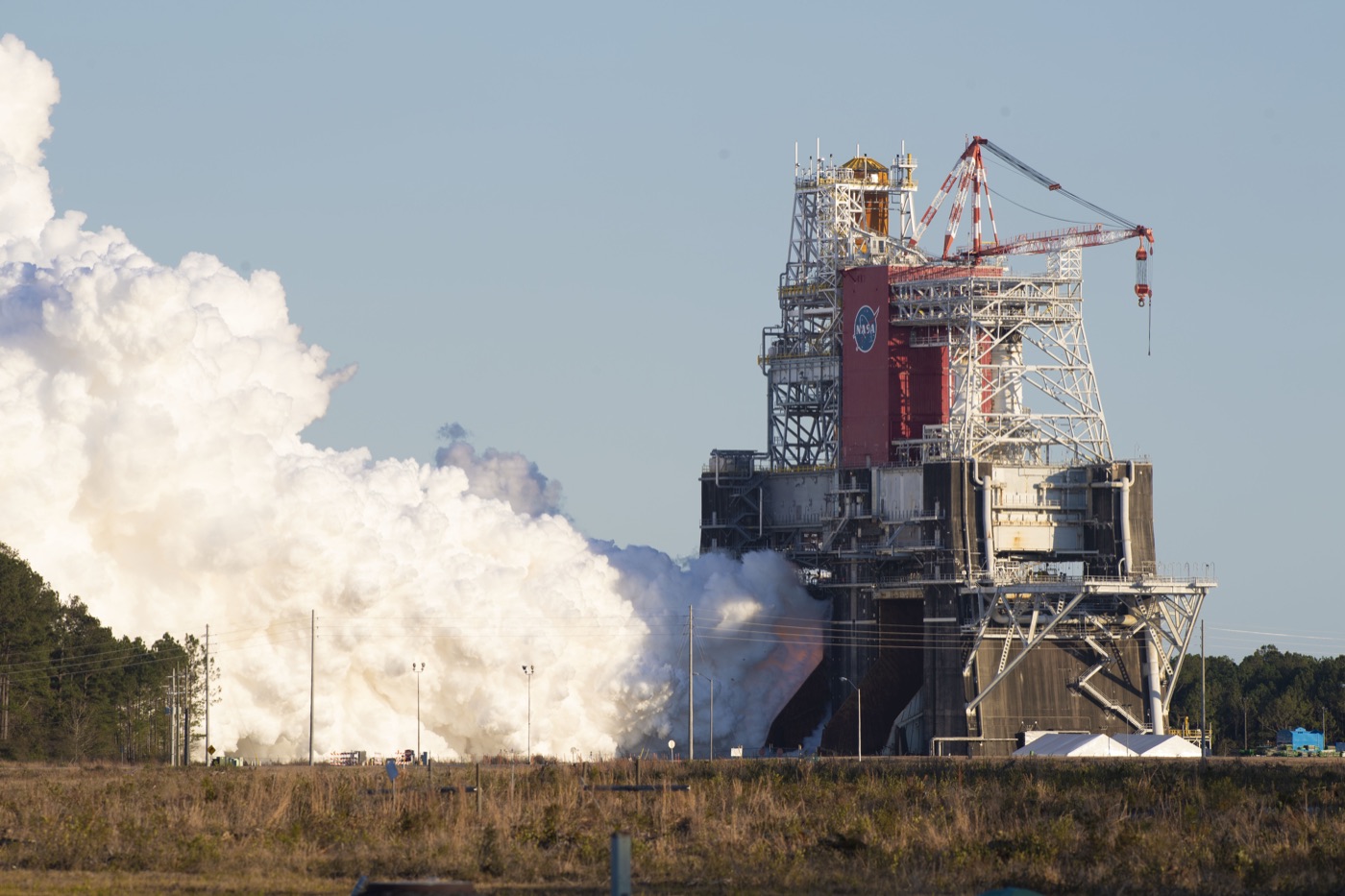
All four RS-25 engines firing during NASA's SLS Green Run hot fire — roughly 1.6 million pounds of combined thrust. (Photo: NASA/Stennis)
Key Differences Between Jet and Rocket Engines
Where the Oxygen Comes From
This is the root difference — everything else follows from it. A jet gets the ~3.4 kg of oxygen it needs per kg of fuel for free from the atmosphere (delivered in roughly 15 kg of air). A rocket pays mass for every gram of oxidizer. Free oxygen is why an airliner can carry 300 passengers across an ocean; carried oxygen is why a Falcon 9 is 95% propellant by mass at liftoff.
Thrust and Thrust-to-Weight Ratio
Jets move a large mass of air a little faster. Rockets move a small mass of gas enormously faster. The rocket approach scales to absurd thrust levels:
- A modern fighter jet engine manages a thrust-to-weight ratio around 8–10.
- SpaceX's Merlin 1D exceeds 180:1 — one of the highest of any machine ever built.
- A single F-1 engine on the Saturn V produced 1.5 million lbf; all five together out-thrust every jet engine ever made, combined many times over.
Fuel Efficiency (Specific Impulse)
Specific impulse (Isp) measures how many seconds one pound of propellant can produce one pound of thrust. Chemical rockets top out around 450 seconds (the hydrogen-burning RS-25). A turbojet, counting only the fuel it carries, reaches an effective Isp of 3,000+ seconds. That ~10x gap is the price of carrying your own oxygen.
Operating Envelope
A jet's world ends where the air does. Practical ceilings sit around 15–20 km, and inlet heating caps speed near Mach 3 (the SR-71's J58s lived right at that edge). A rocket has no such limits — it performs better in vacuum, where the nozzle can expand the exhaust further.
Throttle Response and Control
Jets are slow to respond: spooling a heavy compressor from idle to full power takes several seconds, and aggressive throttle movement risks compressor surge or flameout — both of which you can trigger (and watch the event log narrate) in our turbojet simulator. Liquid rockets, by contrast, respond nearly instantly to valve changes, but many can only throttle within a limited band before combustion goes unstable.
Jet Engine vs Rocket Engine: Side by Side
| Jet engine | Rocket engine | |
|---|---|---|
| Oxygen source | Atmosphere (free) | Carried onboard (paid in mass) |
| Typical thrust | 2,500–134,000 lbf | 100,000–1,700,000 lbf per engine |
| Thrust-to-weight | ~5–10 : 1 | ~70–180 : 1 |
| Specific impulse | 3,000+ s (fuel only) | 250–450 s |
| Exhaust velocity | ~400–600 m/s (turbofan) | 2,500–4,500 m/s |
| Speed limit | ~Mach 3 (inlet heating) | None (orbital velocity and beyond) |
| Altitude limit | ~15–20 km | None — improves in vacuum |
| Burn duration | Hours | Minutes |
| Starting | Spool-up via starter, self-sustains | Ignition sequence, immediate full flow |
So Which Is More Powerful?
Define "powerful" first.
Peak thrust: rockets, no contest. A single Raptor produces more thrust than three record-holding GE9X turbofans.
Useful work per kilogram of propellant: jets, by roughly a factor of ten. No rocket-powered airliner could ever close its business case — the oxidizer mass kills it.
The honest answer: a rocket is a sprinter that carries its own air supply; a jet is a marathon runner that breathes. Each is hopeless at the other's job. That's why spaceplanes keep being proposed with both — and why hybrid designs like the SR-71's turbo-ramjet J58 remain some of the most fascinating engines ever flown.
See a Jet Engine Run, From Spool-Up to Flameout
Reading about compressor surge is one thing; watching N1 climb past light-off RPM while the EGT needle spikes is another. Our free in-browser engine simulator includes a J85 turbojet with a full start sequence — starter spool-up, light-off, self-sustain — plus an event log that explains every state change in plain language. Slam the throttle and see what a real FADEC has to protect you from.
Jet Engine vs Rocket Engine FAQs
Can a jet engine work in space?
No. A jet needs atmospheric oxygen for combustion and atmospheric mass to accelerate. Above roughly 20 km the air is too thin to sustain either, which is exactly why every spacecraft uses rockets.
Why don't airplanes use rocket engines?
Mass and cost. A rocket-powered airliner would need to carry roughly 2.5 kg of oxidizer for every kg of fuel, leaving almost no payload capacity. Rocket-powered aircraft have existed (the Me 163, the X-15) but measured endurance in minutes.
What about scramjets — aren't they jets that go faster than Mach 3?
Yes. A scramjet keeps airflow supersonic through the combustor, dodging the inlet-heating limit; NASA's X-43A reached Mach 9.6. But scramjets only start working around Mach 4–5, so they need a rocket or turbojet to get up to speed first.
Is a turbofan the same as a turbojet?
A turbofan is a turbojet wrapped around a huge fan: the core drives the fan, and most thrust comes from cold bypass air. That's why airliner engines are so efficient and (relatively) quiet, while pure turbojets like the J85 are louder, thirstier, and better suited to high speed.
Which engine is harder to start?
Different hard. A turbojet needs a starter to spin the compressor to self-sustaining RPM before fuel can light — get it wrong and you get a hot start or hung start. A rocket needs millisecond-precise ignition timing — propellant pooling before ignition is how engines explode on the pad.