What Is Vapor Lock? Symptoms and Prevention
Vapor lock interrupts liquid-fuel delivery when heat and low pressure create bubbles. Learn the symptoms, causes, diagnosis, and safe prevention.
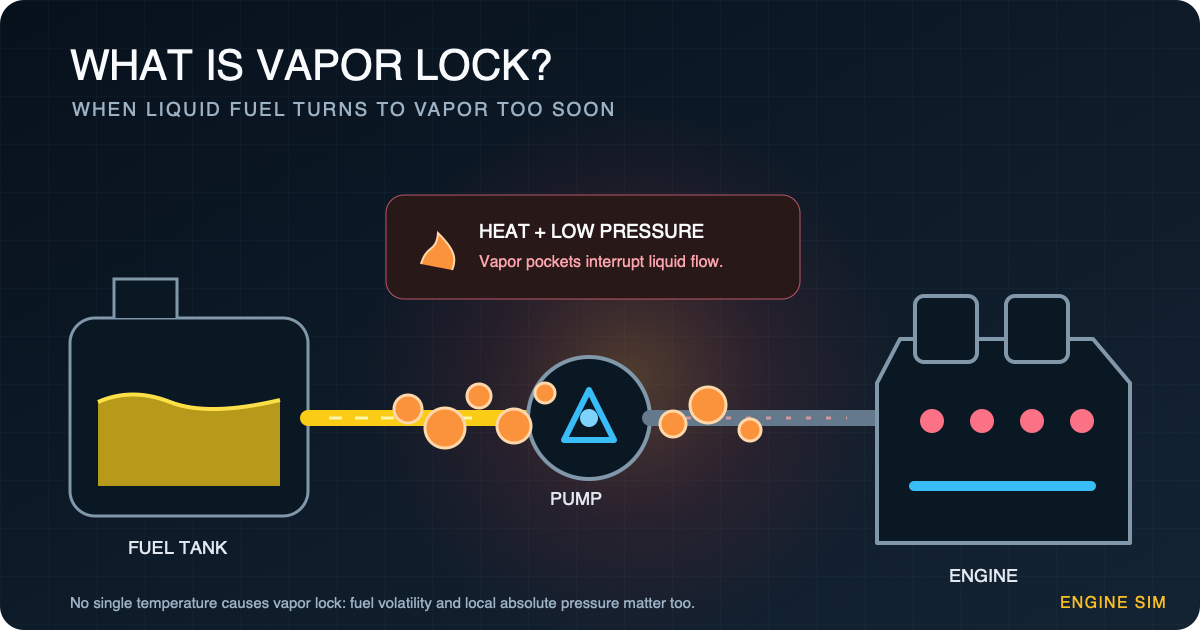
A gasoline engine runs cleanly, coughs to a stop while hot, then restarts after cooling. There is fuel in the tank and the temperature gauge may look normal. The fuel did not run out; it stopped arriving as a usable liquid.
That is the classic vapor-lock story. It is most associated with carbureted and low-pressure systems, including classic cars and some piston-aircraft, marine, motorcycle, and small-engine installations. Modern fuel injection has made it uncommon, not mythical.
Quick Answer: What Is Vapor Lock?
Vapor lock is a partial or complete interruption of fuel flow when gasoline vapor forms inside the delivery system. The resulting pockets can restrict liquid flow in lines and other units or impair a pump before fuel reaches the carburetor or injectors. The engine may hesitate, lose power, stall, or refuse to restart while hot.
Risk rises with high fuel temperature or volatility, low local absolute pressure, turbulence or aeration, and limited ability to move or purge vapor. Cooling can condense the bubbles, so the engine may restart after sitting. That is a clue, not proof; ignition components and fuel pumps can also recover when cool.
Fuel Does Not Need to Reach One Boiling Temperature
Unlike water, pump gasoline is a changing blend of hydrocarbons with different evaporation behavior. The useful concept is vapor pressure: the pressure produced by vapor above a liquid at a given temperature. Heating fuel raises its vapor pressure; lowering pressure around the fuel makes vapor formation easier. When those pressures approach each other inside a line or pump inlet, volatile components can flash into vapor.
That is why no honest diagnosis can say "gasoline vapor-locks at exactly 40 °C" or any other universal temperature. Fuel blend, altitude, line pressure, under-hood temperature, flow rate, and system design all change the margin.
Reid vapor pressure (RVP) is a standardized gasoline-volatility test value; it is not ordinary equilibrium vapor pressure, a universal boiling point, or a vehicle pass/fail test. US summer volatility controls primarily reduce evaporative emissions, but they also illustrate the compromise: fuel must evaporate for cold starting without becoming troublesome when hot.
Why the Suction Side of a Fuel Pump Is Vulnerable
A pump drawing fuel from a tank creates lower pressure at its inlet—exactly where hot gasoline is closest to flashing. If bubbles enter a pump designed for liquid, many pump types lose head or volumetric efficiency. Pressure and flow can fall until combustion weakens or stops.
Pump location therefore matters. Pulling hot fuel through a long, low-pressure line invites vapor; pushing cooler fuel from near the tank keeps most of the line under positive pressure.
The FAA's engine fuel-system handbook identifies the same three broad drivers: reduced fuel pressure, high fuel temperature, and excessive turbulence. Aircraft add an especially clear example of the pressure effect: as altitude increases, lower ambient pressure reduces the fuel's boiling margin even if its temperature has not changed quickly.
What Causes Vapor Lock?
Heat Soak After Shutdown
After shutdown, airflow and fuel flow stop while the exhaust, head, and block remain hot. Heat migrates into stationary lines, a mechanical pump, or the carburetor. A restart ten minutes later can be harder than a cold or immediate restart.
Hot Weather, Traffic, and Heavy Load
Hot weather reduces the starting margin. Slow traffic removes cooling airflow, while sustained load raises exhaust and under-hood temperatures. A marginal system may fail only on one hot, slow journey.
Fuel Lines and Pumps Near Heat Sources
A line near an exhaust manifold, unshielded surface, or stagnant engine-bay air absorbs heat. An engine-driven pump adds another vulnerable component on the hot engine.
Low Inlet Pressure or Restricted Flow
A weak pump, restricted filter, damaged hose, or blocked tank vent can reduce pressure or flow. These faults may encourage vapor and can imitate its symptoms.
Fuel Volatility and Seasonal Changes
More volatile fuel evaporates more readily. Winter fuel aids cold starting; summer fuel is controlled differently. A historical 1995 EPA technical overview links vapor-lock tendency with high volatility and high ambient and engine temperatures, while a later SAE fuel-pump study describes the influence of fuel temperature, ambient pressure, and seasonal or regional fuel properties.
Altitude
Lower atmospheric pressure gives vented, older systems less boiling margin, so the same warm fuel can vaporize more readily at altitude.
What Are the Symptoms of Vapor Lock?
Common reports include:
- Hesitation or surging after the engine and engine bay become hot.
- Loss of power under load, as though the tank were nearly empty.
- Rough running followed by a stall.
- Extended cranking or failure to restart during a hot soak.
- Normal starting and operation again after the vehicle cools.
- Low or erratic fuel pressure during the fault.
None is unique to vapor lock. A hot engine that will not restart may have lost spark, fuel pressure, injector control, compression, or electrical power. Treat "it restarts when cool" as a clue that guides testing, not a verdict.
Vapor Lock vs Similar Hot-Running Problems
| Fault | What is happening | Typical clue |
|---|---|---|
| Vapor lock | Vapor forms in a supply line or pump and restricts liquid delivery | Fuel-starvation behavior appears hot and may clear after cooling |
| Carburetor percolation | Fuel boils in the float bowl after shutdown, disturbing bowl level and mixture | Fuel smell and an over-rich hot restart are common, though bowl depletion can also create starvation |
| Flooding | Too much liquid fuel reaches the intake or cylinders | Wet plugs, strong fuel smell, and a mixture too rich to ignite |
| Weak pump or blocked filter | Liquid-fuel pressure or flow is inadequate | The fault may persist cold and must be confirmed with proper pressure/flow tests |
| Heat-sensitive ignition fault | A coil, module, sensor, or connection stops producing a usable ignition signal when hot | Fuel pressure may remain normal while spark or engine-speed signal disappears |
Vapor lock and carburetor percolation both involve hot fuel, but one starves the engine upstream while the other can make the intake rich. Diagnosis matters.
Why Older Carbureted Engines Suffer More
Older systems often use an engine-mounted mechanical pump to pull fuel through a long line at modest pressure, then feed a vented carburetor above a hot intake manifold.
Modern vehicles usually place an electric pump in or near the tank so it pushes fuel through a closed, pressurized line and rail instead of pulling it a long distance under suction. Positive pressure improves the margin against vapor formation. The 1995 EPA overview notes that improved inline and high-pressure pumps greatly reduced vapor-lock problems. Modern systems are not immune, but vapor lock should not be the default explanation for a fuel-injected car that stalls hot.
Preventing Vapor Lock Safely
Prevention is about preserving pressure, limiting unwanted heat, and maintaining designed fuel flow:
- Keep factory heat shields, cooling systems, ducts, and fuel-line routing intact.
- Use fuel that meets the vehicle manufacturer's specification and is appropriate for the season and region.
- Replace deteriorated hoses, restricted filters, faulty vents, and weak pumps with correctly specified parts.
- Have fuel pressure and flow tested while the fault is present, alongside ignition and electrical checks.
- Let a qualified technician assess any proposed changes to pump location, line routing, insulation, return flow, or system pressure.
What Should You Do if an Engine Stalls Hot?
Move safely off the road if possible and follow the vehicle manual or roadside-assistance guidance. Do not open, cut, reroute, or pressurize a hot fuel system as a roadside test; gasoline can ignite on an exhaust surface or spark. A leak, persistent fuel odor, smoke, or fire risk calls for evacuation and emergency help.
Once the vehicle is safe, the useful diagnosis compares specified fuel pressure and flow with spark or engine-speed signal while the fault is present. Cooling and a successful restart support the hypothesis but do not confirm it. Use the manufacturer's service procedure or a qualified technician.
Inspect the Vapor-Lock Warning in the Simulator
Open the gasoline inline-four engine simulator, start it at the default temperature, then move AMBIENT TEMP upward. Above 313 K, the current model sets a VAPOR LOCK warning and changes the fuel-system schematic, letting you inspect where this simplified fault is represented.
There is an important current limitation: the inline-four's modeled pump has enough spare capacity that the slider's reachable range may not reduce delivered fuel or RPM even while that warning is active. The simulator uses an ambient-temperature gate above 313 K (about 40 °C) as a teaching indicator; it is not a claim that real gasoline always vapor-locks at 40 °C, and it is not a diagnostic threshold. Real behavior depends on local fuel temperature and pressure, volatility, altitude, flow, routing, and hardware.
The schematic illustrates how fuel starvation would interrupt the four-stroke cycle. Contrast that with engine knock: knock is abnormal combustion in the cylinder; vapor lock is a delivery-system problem.
Vapor Lock FAQs
Does vapor lock only happen in carbureted engines?
No, but it is far more common in carbureted, low-pressure systems. In-tank pumps and pressurized rails remove several conditions that made it common.
At what temperature does gasoline vapor-lock?
There is no universal temperature. Vapor formation depends on local temperature and pressure, fuel volatility, altitude, flow, and hardware.
Is vapor lock the same as an engine overheating?
No. Under-hood heat encourages it, but the coolant gauge can remain normal while the fuel system absorbs heat locally.
Can vapor lock damage an engine?
Vapor lock usually causes power loss or stalling rather than one distinctive internal-damage mode. Prolonged abnormal or lean operation can be harmful in some applications, but the immediate risks are loss of propulsion and fire exposure around hot fuel.
Is diesel gelling a type of vapor lock?
No. Vapor lock is liquid fuel turning to vapor in a hot or low-pressure system. Diesel gelling is a cold-weather wax restriction.
How can I confirm vapor lock?
Test fuel pressure and flow, pump operation, tank ventilation, ignition, and electronic data during the fault. Because gasoline is flammable and systems retain pressure, follow the service procedure or use a qualified technician.
Sources and Further Reading
- FAA Aviation Maintenance Technician Handbook: Engine Fuel and Fuel Metering Systems
- US EPA: Gasoline Reid Vapor Pressure
- US EPA (1995): Technical Overview of Reformulated Gasoline and Engine Performance
- SAE: Establishment of a Test Method for Fuel Pump Vapor Lock