How a Four-Stroke Engine Works (All 4 Strokes Explained)
A four-stroke engine turns exploding fuel into smooth rotation in four steps — intake, compression, power, exhaust. Here's what happens in each stroke.
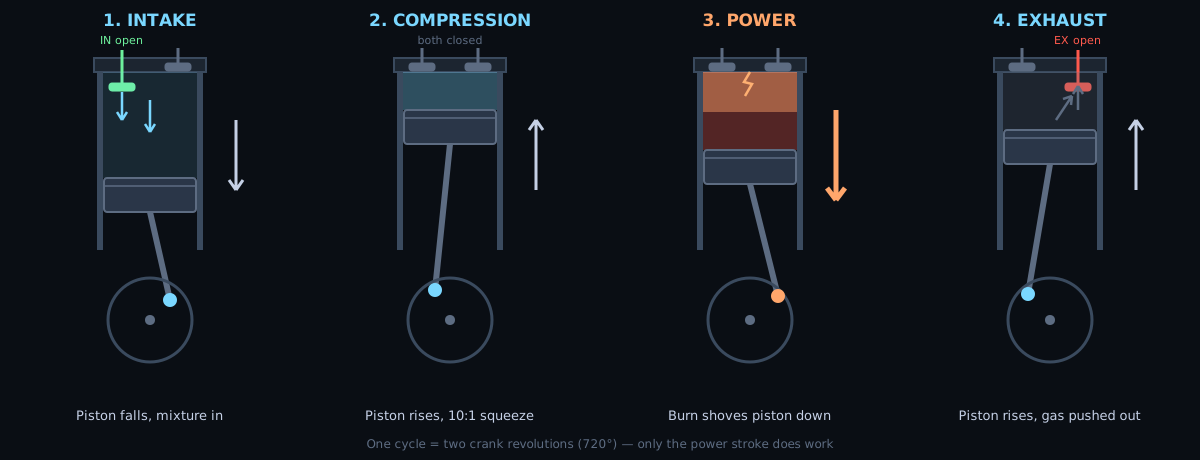
Open the hood of almost any car built in the last hundred years and you'll find the same machine: a four-stroke piston engine. The fuel changed, the electronics changed, the materials changed — the cycle itself hasn't. Nikolaus Otto got it right in 1876.
The idea fits in one sentence: trap an air-fuel mixture in a cylinder, squeeze it, ignite it, and let the explosion shove a piston that turns a crank. The detail is where it gets interesting — and where most explanations go fuzzy. Let's do it properly, stroke by stroke.
Quick Answer: What Are the Four Strokes?
One full cycle takes two crankshaft revolutions (720°) and four piston strokes:
- Intake — piston moves down, intake valve open, cylinder fills with air and fuel.
- Compression — both valves closed, piston moves up, mixture squeezed to a tenth of its volume.
- Power — spark ignites the mixture, pressure slams the piston down. This is the only stroke that produces work.
- Exhaust — piston moves up, exhaust valve open, burned gas pushed out.
Then the cycle repeats — at 6,000 RPM, each cylinder runs the full sequence 50 times per second.
Stroke 1: Intake
The piston descends from top dead center with the intake valve open. The growing cylinder volume drops the pressure, and atmospheric pressure pushes air in through the intake tract — the engine doesn't "suck" so much as the atmosphere shoves.
How much air gets in is the single biggest factor in how much power the engine can make. The throttle plate is literally just a restriction in this path: close it and the cylinder fills less, burn less fuel, make less torque. This is why "wide open throttle" matters — it's the engine finally breathing freely.
Stroke 2: Compression
Both valves close and the piston rises, squeezing the mixture into the small volume above the piston — typically a compression ratio of 10:1 to 13:1 for gasoline engines.
Why bother compressing? Thermodynamics: the more you squeeze the charge before burning it, the more work you can extract from the expansion afterwards. Higher compression ratio means higher efficiency — up to the point where the heat of compression ignites the fuel before the spark does. That uncontrolled ignition is engine knock — destructive enough that we wrote a whole post on what causes it and how to stop it.
Diesel engines exploit this on purpose: at 16:1 to 23:1 compression, the air alone gets hot enough (over 800 K) that fuel injected into it ignites spontaneously. No spark plug needed.
Stroke 3: Power
Just before the piston reaches the top, the spark plug fires. The flame front takes a few milliseconds to sweep across the chamber — which is why ignition happens early: the goal is peak pressure arriving just after top dead center, when the crank geometry can best use it.
Pressure spikes to 50–100 bar and drives the piston down. The connecting rod turns that linear shove into crankshaft rotation — the crank-slider mechanism that's been the heart of every piston engine ever built.
Note what this means: in a four-cylinder engine at idle, each cylinder fires only once per 720°, so the crank gets four discrete kicks per two revolutions. The flywheel's job is to smooth those kicks into continuous rotation.
Stroke 4: Exhaust
The exhaust valve opens slightly before bottom dead center (while there's still useful pressure to start gas moving), and the rising piston pushes the burned charge out. At the top, for a few degrees, both valves are open — valve overlap — using the momentum of outflowing exhaust to help pull in fresh charge. Race cams stretch this overlap for top-end power at the cost of a lumpy idle.
Then the intake valve opens fully, the piston descends, and we're back at stroke one.
The Parts Doing the Work
Eight components carry the whole cycle:
- Piston — the moving wall that compresses the charge and receives the power stroke.
- Piston rings — seal combustion pressure above the piston and scrape oil below it.
- Connecting rod — links piston to crank, converting linear shove into rotation.
- Crankshaft — the rotating output; its throws set the stroke length.
- Camshaft — geared to spin at half crank speed (remember: 720° per cycle), opening each valve at the right stroke.
- Valves — intake lets charge in, exhaust lets burned gas out; both sealed shut for compression and power.
- Spark plug — fires once per cycle, just before top dead center.
- Flywheel — stores rotational energy to carry the crank through the three non-power strokes.
From Explosions to Horsepower
Two terms get conflated constantly, so here's the clean version:
- Torque is twist — how hard each power stroke shoves the crank. It's set by how much mixture the cylinder burns per cycle.
- Power is torque times speed — how often those shoves happen. In imperial units: horsepower equals torque (lb-ft) times RPM divided by 5,252.
That formula explains real dyno curves. Torque peaks where the engine breathes best (its volumetric-efficiency sweet spot); power keeps climbing past it because rising RPM outweighs slowly falling torque — until breathing collapses and both fall. You can sweep a virtual engine on a dyno and watch exactly this in our free engine simulator.
Why More Cylinders? And Why Does a V8 Sound Like That?
One cylinder gives one bang per 720°. Eight cylinders, fired at even intervals, give a bang every 90° — smoother torque, smaller flywheel, and a higher exhaust pulse frequency.
The sound of an engine is mostly firing frequency: a four-cylinder at 6,000 RPM fires 200 times a second; a crossplane V8 produces its signature burble because its firing intervals are uneven per bank, layering pulse spacings the ear reads as that low, syncopated rumble. Same physics, different firing order, completely different character.
Watch the Whole Cycle Run
Diagrams freeze the engine; the real thing is a blur of valves and flame arriving 50 times a second. In our in-browser engine simulator you can crank an inline-four or a V8, watch the pistons and combustion events in 3D, pull a dyno curve, and read an event log that narrates every state change — starter engagement, first fire, rev limiter, even fuel starvation — in plain language. It's the diagram, running.
Four-Stroke Engine FAQs
Why is it called the Otto cycle?
After Nikolaus Otto, who built the first practical compressed-charge four-stroke in 1876. The thermodynamic idealization of his engine — isentropic compression, constant-volume heat addition, isentropic expansion — still carries his name. The full derivation of why compression ratio drives efficiency, and where knock sets the ceiling, is in The Otto Cycle Explained.
What's the difference between a four-stroke and a two-stroke?
A two-stroke fires every revolution instead of every other one, using ports and crankcase pressure instead of valves. More power per displacement, but dirtier and thirstier — which is why two-strokes survive mainly in chainsaws, dirt bikes, and giant ship engines.
What actually limits an engine's redline?
Mostly valvetrain control and piston acceleration. Past a certain speed the valves "float" (springs can't close them fast enough) and connecting-rod stress grows with the square of RPM. The rev limiter cuts spark or fuel just below that point — hit it in the simulator and the event log will tell you.
Why does an engine need to idle? Why not just stop?
A four-stroke produces no power below self-sustaining speed; it needs stored rotational momentum to carry the crank through the three non-power strokes. Drop below idle speed without enough torque and the cycle collapses — a stall. Start-stop systems "solve" idling by using a beefed-up starter to relaunch the cycle on demand.
Is a jet engine also a four-stroke?
No — a jet runs the same conceptual steps (intake, compression, combustion, exhaust) but continuously and simultaneously in different parts of the machine, rather than sequentially in one cylinder. We compare the two approaches in Jet Engine vs Rocket Engine.